

Guides
Windows for Desert Climates: Sand, Dust and Sealing
Dust is not weather. It arrives in a wind event, settles into every gap it can find, and stays there until something removes it. On a window it works on the seals, the track and the hinges at the same time, and the damage shows months later as a sash that no longer closes flat. This guide covers what a dusty site asks of a window, and how to keep one working through the season.
What dust does to a window
The coarse fraction scratches and the fine fraction packs. On a sliding window the track collects both, and the rollers grind the mixture into the rail until the sash runs out of line. On a casement the damage is at the gasket, where grit sits between the seal and the frame and holds the leaf off its closing face. Hinges and lock points collect the same film and turn a smooth action into a stiff one.
Three lines that keep it outside
Sealing in dust is about compression, not thickness. The first line is the EPDM foam gasket running the sash rebate; the second is the closing pressure that keeps that gasket compressed; the third is the drainage path that lets what passes the first two leave the frame. A multi-point lock does the second job by pulling the sash onto the gasket along its full height, which is why a single latch leaves a gap at the far stile.
Drainage that clears itself
A sill that drains through a narrow slot blocks first. What a dusty site needs is an open path with a fall to the outside, so water carries the grit out instead of depositing it at the bottom of a chamber. Check on the drawing where drainage leaves the frame, and whether the setting blocks sit across it. A blocked weep does not announce itself; it shows as a damp line inside after the first rain.
Slider or casement on a dusty site
A casement seals better, because the leaf closes onto a gasket rather than sliding past one. A sliding window cannot compress its seal the same way, so the track does the work and the clearance has to be set for the site. Sliders remain the practical choice for a wide balcony front, and they need a cleaning routine rather than a different section. Where the opening is small, the casement is the simpler answer.
A cycle for the season
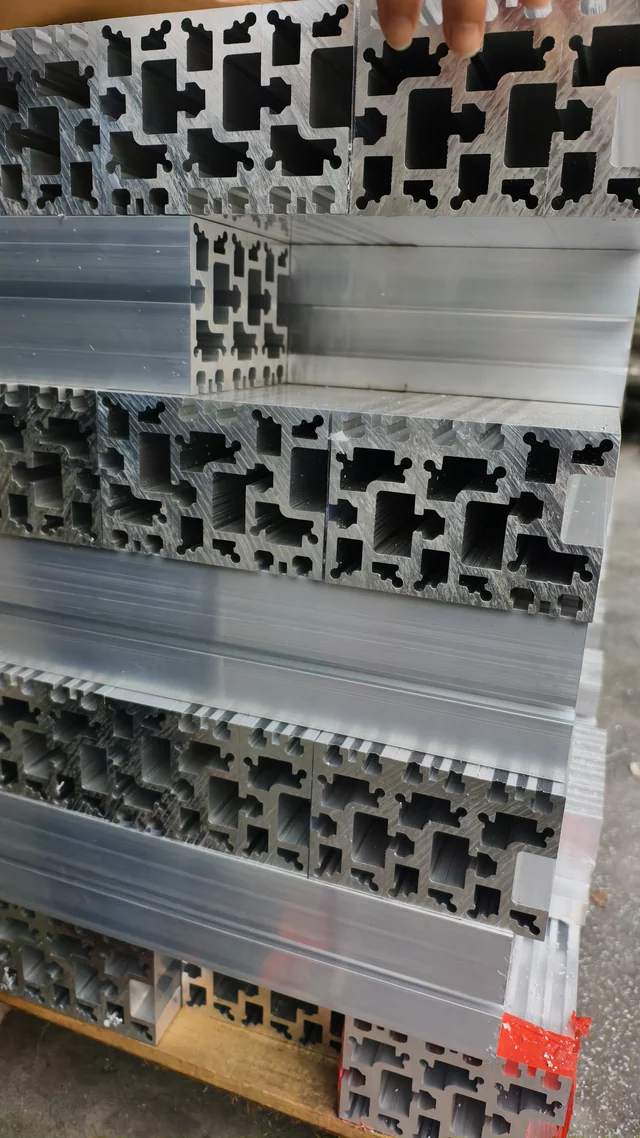
Maintenance on a dusty site is a sequence rather than a repair. Flush the drainage before the rains, wipe the gasket faces so they can compress again, clear the track bed and check the rollers, then look at the lock points for grit packed into the keepers. Recoat a worn finish before the substrate shows, since a coating touched up early covers a small area. A sample profile shows what the sealed joint should look like.
FAQ
Frequently asked
Do aluminium windows keep sand out?
They keep most of it out when the leaf closes onto a compressible gasket and the sill drains openly. No window is dust tight through a wind event, and the useful question is what happens afterwards: grit that leaves with the water does no harm, while grit packed into a closed channel grinds the moving parts.
Which is better in dust, a casement or a slider?
A casement, on sealing. The leaf compresses onto the gasket around the perimeter, so there is no travel path for grit to enter. A slider needs clearance to move, and that clearance is where dust collects. For a wide front the slider is still the right window, provided the track is cleared as part of the routine.
Where does dust damage a window first?
At the moving parts. Rollers grind grit into the track, hinges stiffen at the pivot, and lock keepers pack solid until the handle needs force. The seals come next, because grit held between gasket and frame stops the leaf closing flat. Both are visible in an inspection long before they become a repair.
How often should a window be cleaned on a dusty site?
After the dusty season rather than on a fixed date, and again before the rains. The sequence matters more than the interval: clear the track, flush the drainage, wipe the gasket faces, then check the lock points. A window cleaned in that order closes as it did when it was installed.
What should a specification say for a desert site?
Name the gasket material, require the drainage path to be shown on the section, and ask for the closing hardware that pulls the sash onto the seal. State the finish, since sun and grit work on a coating together. The dimensional pack as a PDF, with CAD on request, is where those answers belong.
Send your opening schedule
Series, glazing and finish come back as one quotation, with the full dimensional pack on PDF and CAD on request.